AI-Enhanced Negotiations: Key Takeaways from Our CASBO 2026 Session

This week at CASBO Con 2026 in San Diego, Litix VP of Data Products Lydia Butler-Orr joined Bob Whittenberg, Assistant Superintendent of Business Services, and Kandace Page, Executive Director of Finance — both from El Dorado Union High School District — to present "AI-Enhanced Negotiations: Smarter Strategies for Better Outcomes."
The session couldn't have been more timely. California is in the middle of the most significant wave of teacher labor actions in decades. More than a dozen districts across the state are currently at an impasse with their unions. Strikes have already disrupted classrooms in San Francisco and West Contra Costa, LAUSD educators have authorized a walkout, and districts from Sacramento to Anaheim are bracing for what comes next.
For CBOs and business services leaders, the message is clear: preparation has never mattered more — and the tools available to support that preparation have never been better.
Here's a summary of what we covered at the event.
The stakes are real — and rising
Salary and benefits represent 80–85% of most California district budgets. A single percentage point salary increase can cost millions annually, and multi-year agreements lock in obligations well beyond current revenue projections. Add COLA uncertainty and the compounding effects of step-and-column progression, and the fiscal risk of an underprepared negotiation team becomes significant.
Beyond the budget, the consequences of getting negotiations wrong ripple through operations and community trust. Poor agreements create years of implementation friction. Strikes damage relationships with families and generate media scrutiny. Settlement outcomes affect future elections and bond measures.
In short, the quality of your bargaining preparation directly impacts your district's fiscal health for years to come.
Negotiation best practices that still matter
AI doesn't change the fundamentals. The session reinforced the practices that experienced negotiators already know work:
Before you sit down at the table, assemble your data infrastructure — salary schedules, step-and-column costs, health benefit trends, STRS/PERS projections, and comparable district data. Align your board, superintendent, and legal counsel on priorities and walk-away positions before the first session. Audit every article of your current contract and flag grievance history, ambiguous language, and provisions that need modernizing.
At the table, designate one spokesperson. Take real-time notes of every proposal and counter. Use tentative agreements to lock in progress. Caucus frequently — never negotiate without time to think. And critically, cost every single counter-proposal before presenting it.
What AI changes is the speed, depth, and confidence with which you can do all of this.
Where AI changes the game
The session walked through six practical ways AI strengthens your management team's negotiation preparation:
- Financial modeling and costing. Model salary schedule scenarios, step-and-column movement costs, and benefit projections across multiple years and assumptions — instantly, not over days of spreadsheet work. This is the highest-ROI use case for AI in negotiations. Every proposal should be costed before it leaves your lips.
- Contract language analysis. Upload your MOU and use AI to flag ambiguous language, identify inconsistencies, and compare proposed language to standards from comparable districts. This is your second-highest ROI — catching ambiguity now prevents years of grievance pain later.
- Comparative research. Rapidly survey settlement data from comparable districts. Synthesize pattern bargaining trends. Identify defensible comparables based on enrollment, geography, and cost of living — not just whoever happens to be nearby.
- Proposal drafting. Use AI to draft initial contract language, counter-proposals, and tentative agreement summaries, then refine with your legal team. AI accelerates the drafting; your attorneys ensure it's airtight.
- Communication support. Draft board updates, community communications, staff FAQs, and media talking points. Ensure consistent messaging across all stakeholder groups — especially critical during impasse or strike scenarios.
- Preparation and simulation. Use AI to role-play as a union negotiator and push back on your proposals. This helps your team anticipate likely arguments, identify weak points in your positions before the table, and practice delivering confident, data-driven responses.
Litix AI: purpose-built for this work
While general AI tools like ChatGPT and Claude can handle communications drafting and simulation exercises, they don't have access to your state's actual settlement data.
Litix is different. It's built on a secure, proprietary database of historical and recently settled labor contracts — not scraped from the public internet, but meticulously extracted, structured, and verified. This means when you ask Litix to compare class size language across your neighboring districts, or benchmark total compensation including health benefit contributions, stipends, and fringe benefits, you're getting answers grounded in real contract data with full source attribution.
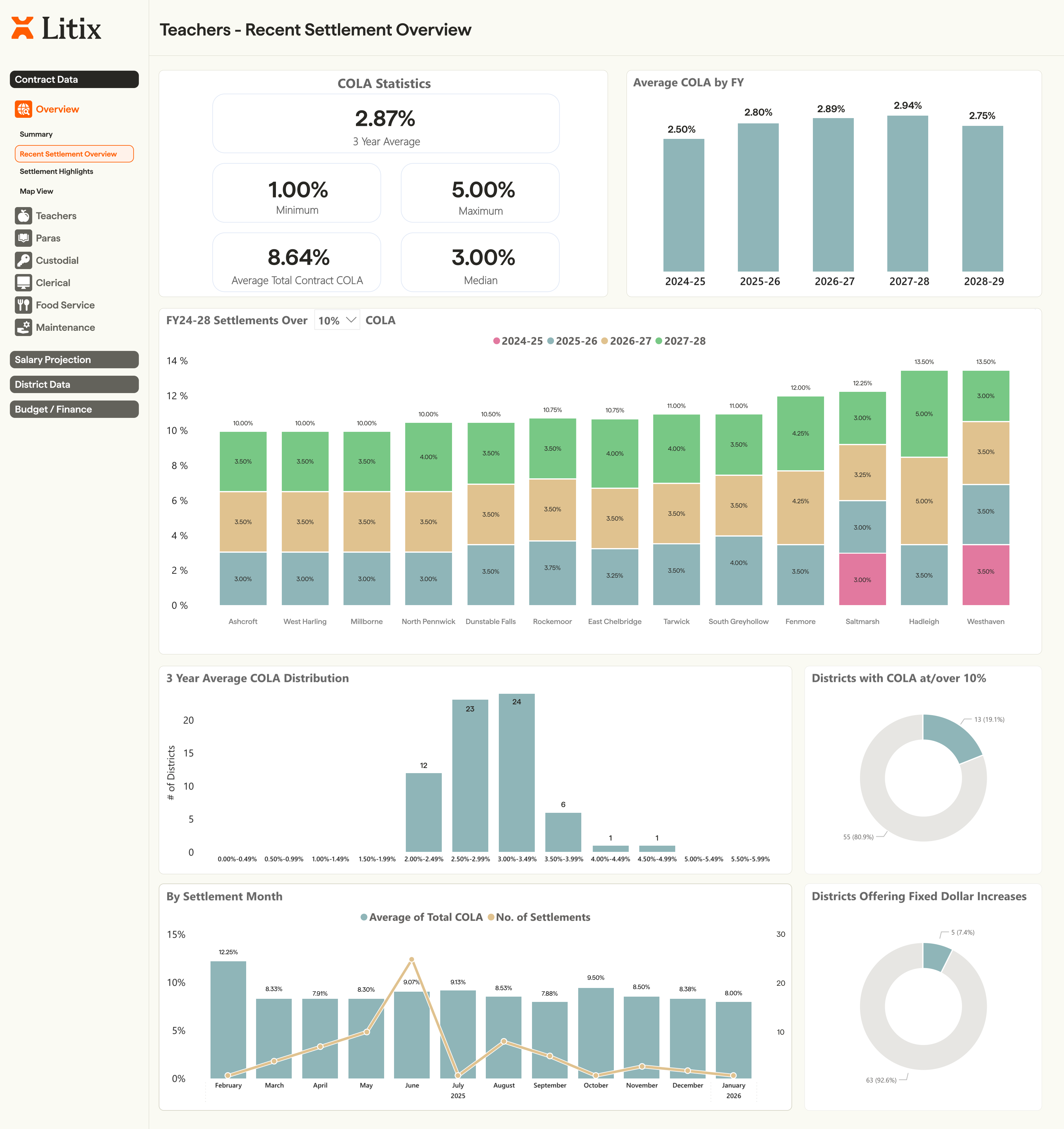
The session included live demonstrations of Litix comparing class size provisions across neighboring districts (highlighting hard caps, soft caps, and ratios with direct links to source contracts) and the Litix Salary Suite running what-if scenarios on three-year budget projections with different raise structures.

Ethical guardrails matter
The session also addressed what responsible AI use in negotiations looks like:
- Protect confidential information. Never input privileged attorney-client communications, individual personnel data, or undisclosed board direction into public AI platforms. Use enterprise-grade tools with data privacy agreements when sensitive information is involved.
- Verify everything. AI can produce plausible-sounding but incorrect analysis. Every AI-generated cost figure, contract comparison, and proposed language must be reviewed by qualified humans before use.
- Be transparent with your board. Inform your governing board that AI tools are part of your preparation process. Establish clear protocols and make sure board members understand that final decisions remain with human leadership.
- Stay compliant. AI doesn't change your duty to bargain in good faith under EERA. Consult legal counsel on any AI-generated contract language before presenting it at the table.
Your action plan: start before your next cycle
You don't need to wait for your next bargaining window to start building your AI-assisted toolkit. The session outlined a three-phase approach:
- This week: Choose your AI tools, set up district-safe accounts, and pull your current MOU and salary schedule into a format you can work with.
- Next 30 days: Run your first salary scenario model. Audit three contract articles for ambiguous language. Draft your opening proposal outline with AI assistance.
- Pre-bargaining: Build your comparative district research file. Run a full bargaining simulation with your management team. Establish board communication templates you can deploy quickly if talks get difficult.
Download the full presentation
Want to share these insights with your team or revisit the details? Download the complete slide deck from our CASBO 2026 session.

About Litix
Litix Insights is a data analytics platform purpose-built for K-12 school districts and municipalities preparing for collective bargaining. The platform aggregates thousands of data points — including salary schedules, fringe benefits, and collective bargaining agreements — so administrators can benchmark compensation, model budget scenarios, and forecast settlement implications with confidence. Trusted by over 80% of Massachusetts school districts and expanding rapidly in California, Litix replaces the spreadsheets and guesswork that have historically defined labor negotiations.
Preparing for your next negotiation cycle? See how Litix can help.