Why School Administrators Enter Collective Bargaining at a Disadvantage — and How to Fix It

Collective bargaining is one of the most consequential processes in public education. The outcome of a single negotiation cycle can shape a district’s budget for years, affect its ability to recruit and retain talent, and determine whether students, families, and entire school communities experience the disruption of a labor action.
In 44 states, teachers and their employers negotiate through unions over wages, benefits, class sizes, and working conditions — agreements that can span hundreds of pages and govern virtually every aspect of how a district operates.
And yet, for all its significance, there's a fundamental imbalance in the historical process that hasn’t been addressed: school administrators consistently go into negotiations with a fraction of the compensation data that unions sitting across the table possess.
How the Asymmetry Works
Teachers' unions operate within large, well-resourced national and state networks. The National Education Association and the American Federation of Teachers, along with their state affiliates like the California Teachers Association, maintain dedicated research staff, compile salary and benefits data across districts, and share negotiation strategies and settlement outcomes with local chapters.
When a local union sits down at the bargaining table, the rep often arrives armed with detailed comparisons of what neighboring districts pay, what recent settlements looked like regionally, and where the leverage points are.
School districts, by contrast, negotiate largely in isolation. A superintendent or chief business officer preparing for negotiations is typically left to cobble together compensation data through time-consuming manual methods: calling colleagues in neighboring districts, compiling information into spreadsheets, commissioning one-off studies from labor attorneys billing at hundreds of dollars per hour, or simply relying on outdated salary surveys that may be months or even years old by the time negotiations begin.
The result is that district leaders frequently walk into what may be the most financially significant conversation of their tenure without a clear, current picture of how their compensation packages compare to the broader market — and the information they do have is often anecdotal, outdated, or even inaccurate.
This isn't a hypothetical problem. As AASA (the School Superintendents Association) has documented that this asymmetry can stretch negotiations - which routinely become adversarial as they drag on - from 3 to 18 months long.
In one illustrative case, a small Illinois district's teachers initially demanded a 30 percent raise while the board was contemplating 5 percent — a gap that reflected, in part, fundamentally different interpretations of what comparable districts were paying. Without reliable, shared data, both sides were essentially arguing from different versions of reality.
The Real-World Consequences Beyond the Bargaining Table
When districts negotiate without adequate data, the consequences ripple far beyond the bargaining table — reaching into classrooms, homes, and communities.
Research from the National Bureau of Economic Research analyzing 772 teacher strikes between 2007 and 2023 found that compensation was the primary driver in 89 percent of cases. Those strikes disrupted the education of approximately 12 million students, resulting in an estimated 48 million days of idle student time over that sixteen-year period.
While the research found that strikes did ultimately lead to average compensation increases of about 8 percent over five years, strikes also came with significant costs — strained relationships between educators and administrators, disrupted learning (particularly in strikes lasting more than 10 days, where measurable impacts on math achievement were observed), and a political and emotional toll on entire school communities. For families, strikes mean lost work time, scrambled childcare, and disrupted routines — burdens that fall disproportionately on low-income households least able to absorb them.
The point here isn't that teacher compensation demands are unreasonable. Educators deserve fair pay and adequate resources, and the data consistently shows that strong unions help channel resources toward classrooms. The point is that many of these protracted disputes could be shortened — or potentially avoided — if both sides started from the same set of facts.
When a union arrives at the table with detailed regional salary comparisons and the district is working from a spreadsheet assembled by calling around to a handful of neighbors, the negotiation isn't really about finding the right number. It's about arguing over whose data is more accurate — a debate that breeds mistrust rather than resolution.
Why School Districts Still Lack the Data They Need
It's worth emphasizing what this data gap is not about. It's not about districts trying to underpay educators or avoid fair settlements. Most superintendents and school boards genuinely want to offer competitive compensation. They understand that attracting and retaining great teachers is fundamental to their mission.
The problem is structural: there has simply been no systematic, accessible way for district leaders to access the kind of real-time, comprehensive compensation benchmarking data they need to negotiate confidently and fairly.
Consider the contrast with virtually any other sector. A hiring manager at a private company can pull real-time salary benchmarks from multiple platforms in minutes. A school superintendent preparing for a negotiation that will determine how millions of taxpayer dollars are allocated? They're often starting from scratch, every single cycle - often with anecdotal, outdated, or even inaccurate data.
In California, where districts must review contract terms at least every three years under the Rodda Act, the challenge is particularly acute. Ed-Data has noted that both sides in California negotiations often rely on disparate salary schedules for comparisons and interpret available revenues differently. Unless both sides are working from the same data foundation, the negotiation becomes about whose numbers to trust rather than what’s actually fair and sustainable.
Better Data, Better Outcomes for Districts and Students
When school administrators have access to the same caliber of compensation intelligence that unions do, something important shifts: the conversation moves from adversarial to analytical.
Instead of debating whether a district's pay is competitive, both sides can look at the same benchmarking data and focus on what a sustainable, fair agreement actually looks like given the district's financial reality and regional market conditions.
This doesn't mean negotiations become easy or that disagreements disappear. But it does mean that the foundation of the conversation is rooted in shared facts rather than competing narratives. And that's where better outcomes come from — for districts, for educators, and - most importantly- for the students and communities they serve.
Faster negotiations mean less time spent in the adversarial posture that AASA describes, where prolonged processes lead to boycotts, work-to-rule actions, and community division. More informed negotiations mean settlements that districts and municipalities can actually sustain over the life of the contract, reducing the budget surprises that force painful cuts elsewhere. And equitable negotiations — where both sides are working from comparable data — build the kind of trust that makes the next cycle smoother.
Closing the Gap
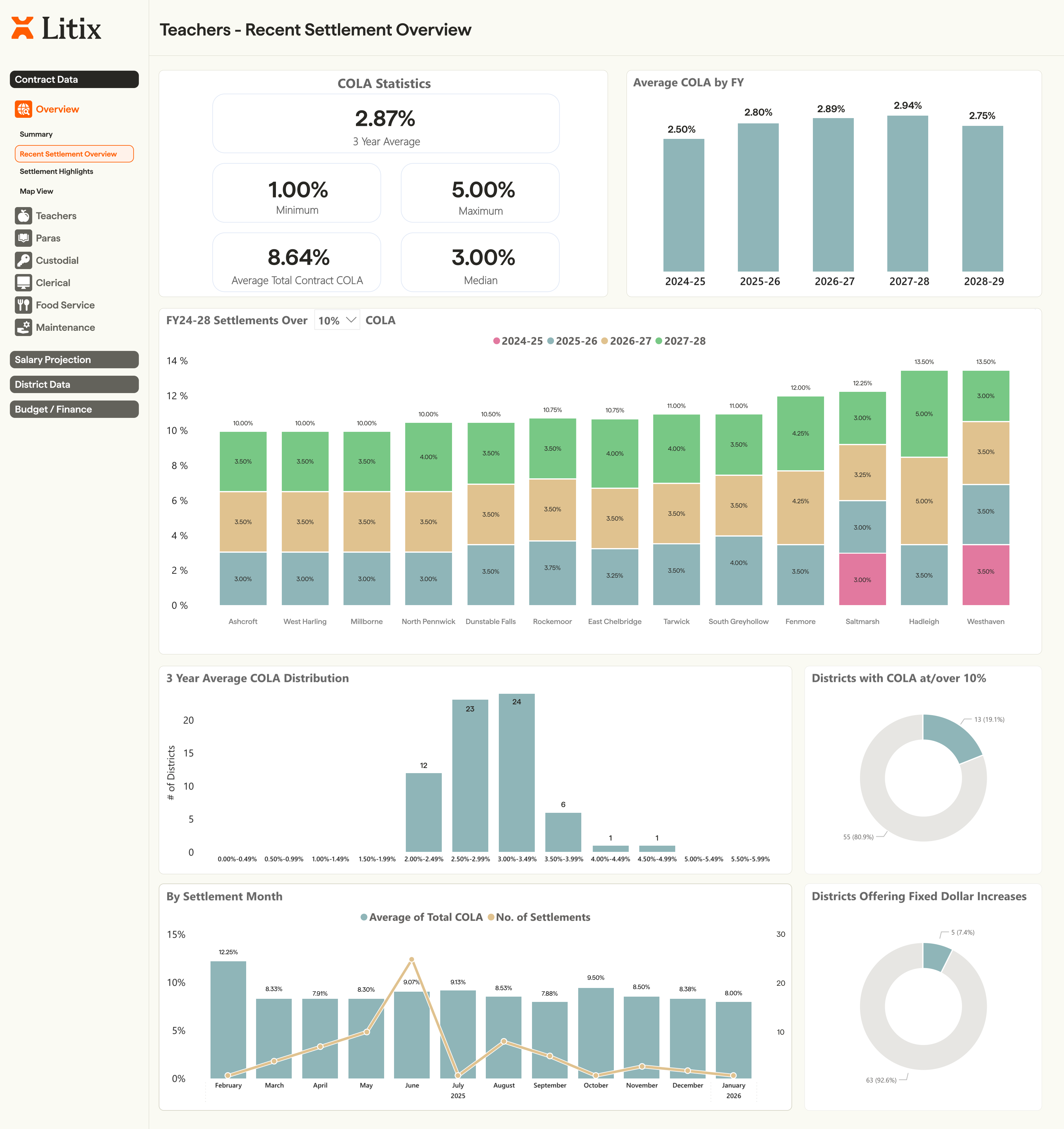
This is exactly the problem that Litix Insights was built to solve. Founded by former school administrators who experienced the data gap firsthand, Litix Insights gives district leaders access to thousands of real-time data points — salary benchmarking, settlement forecasting, fringe benefits analysis, and interactive budget modeling — purpose-built for collective bargaining.
Rather than spending weeks compiling spreadsheets or thousands of dollars on one-off consulting engagements, administrators can instantly benchmark their compensation against comparable districts, model the long-term cost of proposed settlements, and walk into negotiations with the same level of data-driven confidence that unions have had for years.
This isn't about tipping the scales against educators. It's about leveling the playing field so that negotiations can be what they should be: productive conversations between two sides that share a common goal of strong schools and fairly compensated staff, grounded in reliable data rather than guesswork.
Over 80% of Massachusetts school districts already use Litix Insights, and the platform is expanding into California and beyond. Districts that adopt the platform report that it fundamentally changes the dynamic at the bargaining table — transforming negotiations from adversarial battles into data-informed discussions.
Ready to bring data-driven confidence to your next negotiation cycle? Learn more about Litix Insights for K-12.